

Review 2026
24th brenet Status-Seminar

Buildings in the Swiss energy system – From consumer to prosumer
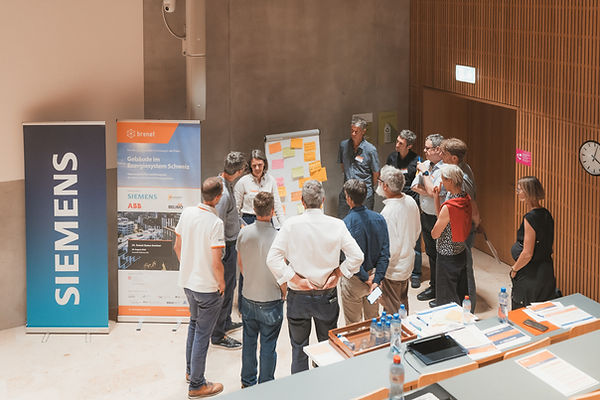
More than 70 participants from research, industry, energy supply, public administration and planning came together in Rotkreuz on 20 August 2026. The seminar focused on the role of buildings in an increasingly decentralised and renewable energy system: buildings not only consume energy, but also produce electricity and heat, store energy and manage when it is used. In this way, they are evolving from pure consumers into prosumers and can help relieve pressure on the grid while supporting the more effective use of renewable energy.
Seminar highlights
-
Buildings interacting with the electricity grid: the expansion of photovoltaics, electric mobility and heat pumps is changing the demands placed on distribution grids. The presentations demonstrated how intelligent controls, dynamic tariffs and energy management systems can help use electricity when it is available, reduce peak loads and make more efficient use of existing grid infrastructure.
-
Flexibility through generation, storage and control: buildings can not only generate energy but also shift some of their consumption and grid feed-in to different times. Heat pumps, battery storage, thermal storage, building automation and electric vehicles offer a range of possibilities. The key is to coordinate these components effectively and ensure that they operate reliably under real-world conditions.
-
From individual buildings to neighbourhoods: local electricity communities, shared energy systems and heating and cooling networks broaden the perspective beyond the individual building. The projects presented showed how buildings, sites, neighbourhoods and energy supply networks can work together more closely in the future.
-
The breadth of applied research: more than 20 speakers presented current work on load analysis, heat pumps, building automation, seasonal and thermal storage, façade-integrated photovoltaics, local electricity communities and heating and cooling networks. Many of the solutions developed are already being tested in pilot and demonstration projects.
-
From technical solutions to widespread application: further research and implementation are particularly needed in monitoring, standardised interfaces, testing under real operating conditions and viable business models. Universities of applied sciences support this process through analysis, simulation, laboratory testing and pilot projects, as well as by transferring research findings into economically viable solutions for buildings and neighbourhoods.
Exchange between research and practice
Keynotes, specialist presentations and moderated cooperation forums provided space for different perspectives and new connections. The direct exchange made one point clear: enabling buildings to fulfil their role in the energy system requires more than technological solutions. It also calls for practical business models, clear regulatory frameworks and close cooperation between research, industry, energy providers and the public sector.
Thank you to everyone involved
Our sincere thanks go to all speakers, moderators and participants, as well as to the Programme Committee, the brenet Board, the brenet member institutes and the organising team. We also thank Lucerne University of Applied Sciences and Arts for its hospitality at the Zug-Rotkreuz campus.
The seminar was supported by the Swiss Federal Office of Energy SFOE, for which we are very grateful. We also thank Siemens, ABB, Solarmarkt and Belimo for their commitment as partners, as well as our communication partners SWKI, energie-cluster.ch and EN Bau.
Technical article
brenet Sustainability Network Status Seminar
Buildings in the Service of the Energy System
Author: Benedikt Vogel, on behalf of the Swiss Federal Office of Energy (SFOE)
Buildings play an important role in transforming Switzerland’s energy supply towards sustainability by providing flexibility in when they draw electricity from the grid and feed electricity into it. This flexibility for stabilising the power grid was the focus of this year’s brenet Status Seminar, a specialist conference organised by the Building and Renewable Energies Network of Technology (brenet).
Held every two years, the brenet Status Seminar showcases research conducted by Swiss universities in the fields of sustainable construction, renewable energy and future-oriented building technologies. In particular, the event presents current projects from the research institutes that have joined forces within the brenet association. Researchers in the building sector have always maintained close links with industry.
This collaboration – and thus the transfer of knowledge from research – must be strengthened further, says Olivier Steiger, Professor at the Lucerne University of Applied Sciences and Arts – Engineering and Architecture (HSLU) and a member of the brenet Board. One way of doing so is the brenet Status Seminar, the 24th edition of which took place in Rotkreuz (Canton of Zug) in mid-August. Around 70 experts in building research used the event, supported by the Swiss Federal Office of Energy and other partners, to exchange experience with industry and public-sector practitioners.
Innovative regeneration in Wallisellen
The thematic focus of this year’s conference was not the building in isolation, but its integration into the energy system. Buildings consume energy and are increasingly producing it as well, particularly solar power. This turns them into so-called prosumers. The conference was therefore entitled “From consumer to prosumer: buildings in the Swiss energy system”. Around three dozen presentations, short talks and discussion forums in Rotkreuz explored this theme. The high practical relevance of building technology research became evident time and again.
The collaboration between research and practice was illustrated vividly when the “SaisonLink” project for Wallisellen’s new energy network was presented at the Status Seminar. Over the next few years, the Zurich municipality intends to develop a district heating network that will mainly use ambient heat (geothermal energy and outside air) and waste heat from a waste-to-energy plant. To keep the associated borehole field – and thus construction costs – as manageable as possible, the ground from which heat is extracted during the winter months is to be regenerated in summer using waste heat from the plant at temperatures of 60 to 70 °C.
“By using the borehole field as a seasonal heat store, we can reduce its size by a factor of three,” says Igor Bosshard, who heads the Thermal Networks business unit at the local energy utility. What is more, by incorporating ambient heat from the outside air and (bio)gas, the field will require just 192 boreholes and will be no larger than a football pitch. The project is based on a feasibility study by the Eastern Switzerland University of Applied Sciences (OST), where Bosshard previously worked as a researcher. According to OST researcher Florian Ruesch, a few examples already exist worldwide of borehole fields being regenerated at high temperatures. What is new, however, is the approach of minimising the number of boreholes and thereby reducing costs.
The problem is not the expansion of photovoltaics
Lukas Küng, CEO of Primeo Netz AG, also contributed a practitioner’s perspective at the Status Seminar. The distribution grid operator based in the Basel region must prepare for the growing number of electric-vehicle charging stations requiring more electricity in future, while decentralised photovoltaic systems feed additional electricity into the grid. “However, it is not so much PV systems and electric vehicles that concern us, but rather the pronounced trend towards denser development,” says Lukas Küng. This will increase the required capacity while reducing the space available for grid infrastructure such as transformer stations. According to Küng, the limiting factor when dimensioning the future electricity grid is therefore neither PV systems nor electric-vehicle charging stations, but heat pumps:
“We are dimensioning the electricity grid so that we can cope with a two-week cold spell.”
Lukas Küng, CEO of Primeo Netz AG
Sabine von Stockar (Minergie) and Beat Fuchs (Siemens) also reported from practice. Maike Schubert (Weisskopf Partner GmbH) presented the work of the SmartGridready association. Energy suppliers, distribution grid operators, service providers and manufacturers have joined forces in the association to develop harmonised solutions for communication between the grid and buildings (grid interface). Such solutions are important for keeping the electricity grid balanced despite solar and wind power production fluctuating sharply over time.
To achieve this balance, they use the flexibility available in buildings – for example electrical consumers such as appliances and charging stations, battery storage systems or PV installations. SmartGridready makes an important contribution in the area of dynamic tariffs: a map provides an overview of where such tariffs can be used, while a list shows which energy management systems (EMS) can optimise operation according to them.
In this way, end customers save energy costs while consuming electricity when it is readily available. Dynamic tariffs have been clearly regulated by law since the beginning of 2026. Eight grid operators serving two million electricity consumers now offer dynamic tariffs. The areas in which these tariffs are available are expected to expand in the coming year, Maike Schubert explained.
Making optimum use of flexibility
The flexibility lying dormant in the building stock should be used as effectively as possible to support a sustainable electricity supply – this guiding principle ran like a thread through the research projects presented at the brenet Status Seminar. These included new tools for the integrated planning of heating and cooling networks, electricity distribution grids and building-integrated photovoltaics. Other research focused on tools for simulating energy networks or intelligent heating controls incorporating weather and electricity-price forecasts.
New forms of electricity consumption communities (ZEV, vZEV and LEG) and the shared use of heat pumps within neighbourhoods were discussed. Other research projects are exploring ways to identify flexibility in the building stock as automatically as possible or to classify buildings using flexibility labels.
Some of these ideas are still at the conceptual stage. Others are already being implemented, at least in pilot operation. At the Status Seminar, Joëlle Clot (HSLU) presented a one-year trial in the St Gallen municipalities of Jonschwil and Henau. The two pilot areas comprised 419 connections. An algorithm controlled electric water heaters and heat pumps in participating households in a grid-supportive manner using smart-meter and forecast data. “Our results show that local flexibility can also pay off economically: in the Henau test region (one transformer and 148 low-voltage cables), around EUR 27,000 in grid expansion costs could be avoided annually by 2040. Part of these savings could be passed directly on to flexible households – amounting to more than 15 cents per kilowatt-hour of PV electricity not fed into the grid,” says Joëlle Clot, summarising one of the study’s main findings. The project was carried out as part of the European ENPLATE research project.
Major expansion required
The brenet Status Seminar demonstrates that a wide range of concepts can ensure the resilience of the energy system even as the use of solar power and other renewable energies grows. It remains to be hoped that renewable energies will actually be expanded accordingly. This is by no means guaranteed today, as Andreas Eckmanns – responsible for the SFOE’s building research programme – warned in Rotkreuz: “We are on track when it comes to reducing per-capita energy consumption, but the expansion of renewable energy must grow exponentially if we are to achieve the targets that have been set.”
--------------------------------------
For further information, please contact Martin Menard (menard@lowtechlab.ch), external head of the SFOE Buildings and Cities Research Programme.
You can find further specialist articles on research, pilot, demonstration and flagship projects in the field of buildings and cities here.
Download complete article including graphics:
STATUS-SEMINAR DES NACHHALTIGKEITS-NETZWERKS BRENET
Photos


Photo Credits: @brenet | Photos: Daniel Dyntar Photography